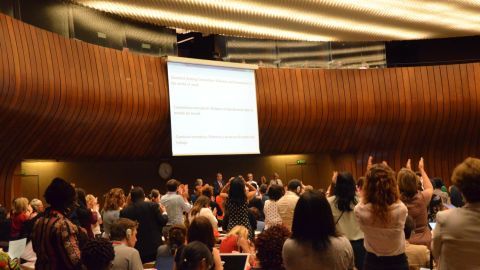
13 June 2025. Palais Des Nations.
“When we fail to recognize the rights of workers, we fail to recognize people, their hopes and aspirations for a better world.”
Exploitation, extractivism, and employment were some of the key themes discussed at the 113th Session of the International Labour Conference (ILC), which held its first normative discussion on setting international legal standards for Decent Work in the Platform Economy.
Despite divergent views on the definitions of “digital platforms” and “digital platform workers,” and on the type of instruments needed to regulate this diverse, complex, and rapidly evolving sector, the 113th ILC reached a historic consensus. With a vote of 1480 in favor and 1064 against, the conference agreed to draft a legally binding Convention, supplemented by a Recommendation, to be presented for adoption at the 114th ILC in 2026.
The Standard Setting Committee acknowledged the urgent need to ensure decent work in the platform economy and recognized a clear deficit in workers' rights in the current landscape. It also noted the sector’s complexity and the pace at which it is transforming due to technological innovation.
Chaired by Benedicto Ernesto Bitono Jr. of the Philippines, the Committee engaged in intense, difficult yet constructive dialogue among governments, employers, and workers' groups regarding the scope, nature, and character of the proposed instruments.
The Committee held 26 sittings, including four extended sessions, with participation from 140 government representatives, 90 employer representatives, and 220 worker representatives, along with several INGOs.
The Governments of Australia, India, and the Governments representing the European Union and Africa, strongly supported the need to offer predictability to the rights of workers by providing a legally binding international instrument. Notably, the Government of Sweden emphasized the importance of including micro, small, and medium enterprises within the scope of the platform economy.
The cooperative movement was represented by Ms. Diana Dovgan, Secretary General of CICOPA (ICA’s sectoral organization on industrial and service cooperatives), who echoed the workers’ group's campaign in calling for a legally binding convention to fully protect fundamental rights at work in the platform economy (June 2, 2025).
ICA-CICOPA Joint Statement
Mr. P. Santosh Kumar, ICA Legislation Director, participated in the final session that adopted the resolutions and conclusions of the Standard Setting Committee on Decent Work in the Platform Economy (June 13, 2025). ILC resolution and Conclusions submitted to the Conference for adoption
The ILC agreed that the upcoming ILO Convention and Recommendation will serve as globally applicable minimum standards to regulate platform work. These instruments aim to balance international consistency with the flexibility to adapt to diverse national circumstances, ensuring coverage for employees, self-employed individuals, and contract-based service providers. This will be achieved through a principles-based Convention, designed for adaptability to accommodate a wide range of global realities. This approach, the Committee noted, would enhance the likelihood of ratification.
Importantly, not all proposed amendments were finalized. Paragraphs 5, 11–25, and 27–77 of the proposed Convention were bracketed and will be revisited during the second session in 2026. The ILC also agreed to conduct several intersessional discussions prior to the release of the Brown Report, which will form the basis for future negotiations.
The Employers’ Group emphasized that the ILO should guide rather than legislate national laws, cautioning against pushing individual country agendas at the expense of global consensus. Meanwhile, the Workers’ Group clarified that their aim was not to oppose economic growth or technological innovation, but to extend the dignity of labor to all platform workers globally.
The presentation of the role of cooperative organizations in this high-stakes legal process—and their responsibility to negotiate on matters of platform work in pursuit of social justice—will be driven by concrete collaboration within the ICA and with its stakeholders: workers, employers, and governments, during this UN International Year of Cooperatives and through the 2026 months leading up to the 114th ILC.