Cooperative Lawyers gather in the lap of Africa for the first time
07 Mar 2026
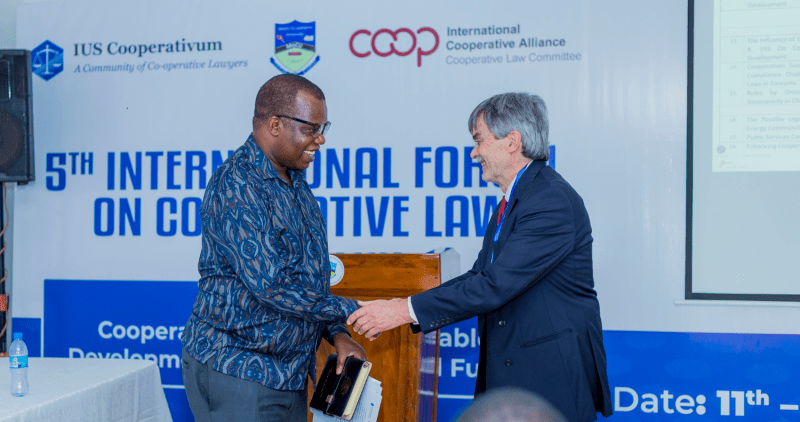
Moshi Co-operative University (MoCU), a premier university initiated by the cooperative movement in Tanzania, and one of the 32 inaugural sites on the ICA Cooperative Cultural Heritage List, hosted the Fifth International Forum on Cooperative Law on 11–12 February 2026.
The event brought together an international community of legal scholars, policymakers, and cooperative practitioners in person and online to examine the evolving role of cooperative law in advancing sustainable development, through plenary discussions, thematic presentations, and parallel sessions. The gathering marked a significant milestone for the Forum, as it was held in Africa for the first time, reflecting the continent’s growing importance in global discussions on cooperative legal reform.
The event was jointly organised by MoCU, the Ius Cooperativum Association, and the International Cooperative Alliance (ICA) through its Global Cooperative Law Committee. Convened under the theme “Cooperative Law and Sustainable Development: Past, Present and Future,” it was led by Dr. Alphonce Mbuya and Dr. Mathias Nkuhi of MoCU in collaboration with members of the ICA’s global and regional law networks.
The Forum was formally opened by Professor Alfred S. Sife, Vice Chancellor of Moshi Co-operative University, alongside Professor Hagen Henry, Chair of the ICA Cooperative Law Committee and Co-Founder of the Ius Cooperativum Association. An address by Dr. Rose Karimi, Regional Director of ICA-Africa, highlighted several key initiatives underway on the continent – including the development of a Regional Cooperative Law Training Course, the launch of the second phase of the ICA–EU Financial Framework Partnership Agreement (FFPA) project and the forthcoming volume African Principles of Cooperative Law.
Jeroen Douglas, Director General of the ICA, emphasised the central role of cooperative legislation in translating the Cooperative Identity Statement into practical rules, rights, and responsibilities for cooperatives and their members, and announced the development of a global cooperative law database.
Santosh Kumar, ICA Director of Legislation, presented an analysis of the potential implications of the International Court of Justice’s Climate Advisory Opinion of July 2025 for cooperative enterprises, and a plenary panel discussed the Model Law on Cooperatives for Africa. Here, participants examined the evolution of cooperative legislation across the continent and discussed how African countries might modernise their legal frameworks while addressing historical influences inherited from colonial legal traditions.
Parallel sessions on the first day broadened the discussion to comparative global perspectives, with presentations on renewable energy community structures under Italian law, public service cooperatives in the Basque Country, cooperative law reforms influenced by ICA principles and ILO Recommendation 193, and legal challenges affecting cooperative development in Tanzania and Chile.
The second day focused on emerging social and technological dimensions of cooperative law, with sessions addressing gender equality in cooperative legislation, the role of women-led cooperatives in strengthening climate resilience, and strategies for enhancing youth participation in cooperative enterprises. Legal frameworks supporting cooperative development in Benin and other jurisdictions were also discussed.
Recent judicial developments were presented by Dr. Ifigeneia Douvitsa, Co-Founder of the Ius Cooperativum Association and member of the ICA Cooperative Law Committee, who analysed decisions concerning cooperatives delivered by the Court of Justice of the European Union. And delegates explored contemporary regulatory challenges, including digital cooperative platforms and the growing importance of environmental, social, and governance (ESG) accountability in cooperative regulation.
A particularly notable presentation was delivered by Professor Maria Amparo Grau Ruiz, Full Professor of Financial and Tax Law at the Complutense University of Madrid and Visiting Professor of Transnational Taxation at Northwestern University, who questioned why cooperatives and other actors within the Social and Solidarity Economy remain largely absent from ongoing international tax policy discussions, despite their significant economic and social impact.
The Forum concluded with reflections from the ICA Cooperative Law Committee summarising key insights and identifying future priorities for strengthening cooperative legal frameworks globally. In the closing keynote address, Professor Hagen Henry discussed the human right to sustainable development, arguing that cooperatives are among the institutional forms best suited to advancing this principle in practice.