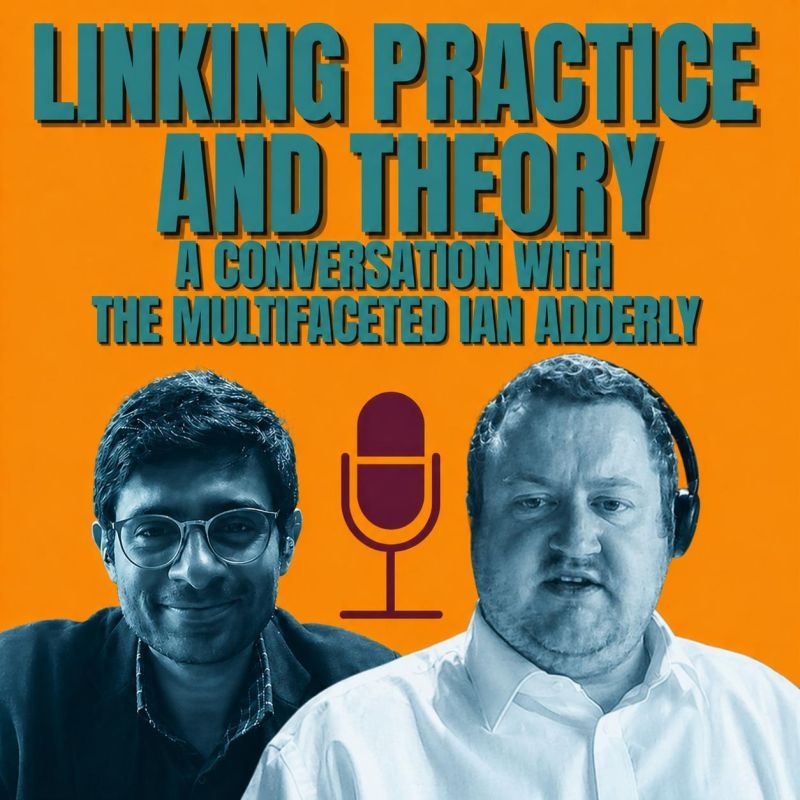
Speaking with Ian Adderley, legal expert and author of Cooperatives: Linking Theory and Practice
07 May 2026
In the latest episode of the ICA Legal Office’s “Interviews with Members and Experts” series, our Director of Legislation, Santosh Kumar, sits down with Ian Adderley, barrister, author, and, until recently, one of the key figures overseeing mutuals and cooperative societies at the UK Financial Conduct Authority. Soon, he will take up a new position as Secretary to the Board of one of the UK’s largest retail cooperative societies. What follows is less a formal interview and more an engaging conversation between people deeply interested in how cooperatives work, why they matter, and where they might go next.
Ian is one of those rare people who can move comfortably between legal theory, practical regulation, and the everyday realities of cooperative business. Raised near Rochdale, only a few miles from the birthplace of the modern cooperative movement, he first encountered cooperatives while studying in Hull. From there, as he jokes during the interview, “once you get into the co-op movement, you can’t really get out of it.”
What exactly makes a cooperative different from an ordinary business with a loyalty card? Why does cooperative law matter? How flexible should legislation be? And how do regulators prevent abuse of the cooperative model without limiting innovation?
Ian’s answers are thoughtful and refreshingly grounded. For him, a cooperative is not simply a business that behaves ethically or votes democratically. What matters is participation. Members are not passive consumers; they are active participants in an enterprise that exists to meet their shared needs. That distinction, he argues, is fundamental.
One of the most fascinating parts of the conversation concerns the UK’s legal framework for cooperatives. British law famously requires a cooperative society to be a “bona fide cooperative society”, a definition that is simultaneously broad, flexible, and somewhat elusive. According to Ian, that flexibility has allowed new forms of cooperation to emerge without the need for constant legislative reform, from multi-stakeholder cooperatives to platform cooperatives and beyond. At the same time, however, flexibility creates a challenge: if the definition is too broad, how do governments, investors, or the public clearly identify what a cooperative actually is?
Then comes one of the interview’s unexpected highlights: cricket. Fifteen of the eighteen first-class county cricket clubs in England and Wales are structured as cooperative societies, including iconic institutions such as Lord’s, The Oval, and Headingley. Far from being a quirky legal detail, Ian sees this as evidence of something bigger. Sport, he argues, is about collective identity, loyalty, and community ownership. If supporters sustain clubs emotionally and financially over generations, cooperative ownership begins to make perfect sense.
The conversation moves through retail cooperatives, building societies, friendly societies, ethical banking, football supporters’ trusts, fair trade, and even Sean Connery’s early days delivering milk for a Scottish cooperative society. Throughout it all runs a single idea: cooperatives tend to emerge when markets fail people. They appear where communities need access, fairness, trust, or stability that conventional systems do not provide.
Ian is the author of Cooperatives: Linking Theory and Practice, an insightful and accessible book for anyone interested in understanding cooperatives beyond slogans or clichés. The book is available through Cooperative Press.
With thanks to Ian Adderley for a conversation full of clarity, humour, and insight.
This episode has been produced under the ICA-EU Partnership (2024–2028), also known as #coops4dev🌍, a five-year international cooperative development programme co-funded by the European Union, aimed at strengthening the ICA network and positioning cooperatives as key actors in international development.